


Over the past two years, as AI has started to become more prevalent in our lives, one thing has evolved in parallel and it has created plenty of controversy: using AI to build music and art.
For me, it’s been transformative. It has helped me re-frame my thoughts, take my writing, and score it like an English teacher. It has made me want to write more, to journal everything, to make a living testimony of the experiences I have lived.
I have been on a quest to write my biography, and over these last two years that process has shifted my thoughts and helped bring healing. Most people who know me know that I’m very visual. I love capturing moments, taking photos of every experience, every situation. Writing became an extension of that, and it started long ago.
In middle school, my teacher Mr. Noel noticed I was writing notes without looking at the paper. He came over, watched for a moment, then asked me how I learned to do that. It didn’t mean much to me at the time, but as my writing grew into poems and small pieces of artwork, that early attention to framing became the foundation of everything I do today.
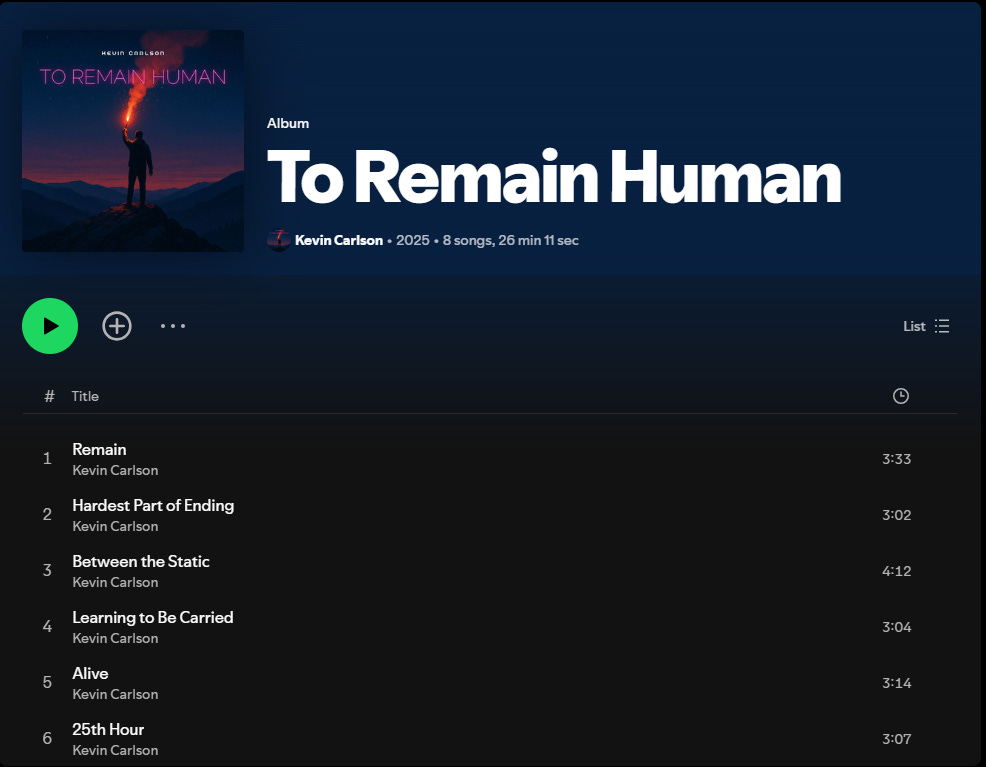
When I began writing To Remain Human, I wasn’t thinking about making an album. I was trying to rebuild a sense of self. After a year of personal and professional upheaval, I found myself surrounded by fragments: notes, journal entries, voice memos, and late-night reflections about loss, endurance, and identity. These weren’t songs at first; they were poems and journal entries.
My friend Alex and I had been experimenting with AI for fun, playing with small pieces of music. It turned serious fast. I started off using OpenAI’s Jukebox, running Python scripts on my laptop and building local LLMs. Then a new platform hit the world called Suno. It streamlined everything I was doing in Jukebox and made it sound incredible.
Remain was born on one of those mornings when the world felt heavier than it should. I remember sitting with the rain as a backdrop, listening to its rhythm against the patio, realizing that I wasn’t trying to move on anymore, I was just trying to breathe. That moment became the first lyric: “I’ve been breaking, I’ve been bending.” From there, each song grew out of a different version of myself. The song was inspired by “Remain” by Mutemath, with my own take on its message and tone, and I wrote more about that connection in a previous post, fittingly titled Remain.
Hardest Part of Ending carried the truth of a relationship that fell apart quietly, not in flames, but in understanding. It was about learning to let go without resentment, and not holding on so tightly just to prove a point. Between the Static became a meditation on numbness, the silence that follows when everything executed, finally collapses. Learning to Be Carried was surrender, the first realization that healing doesn’t always look heroic. It was my close friends who carried me through that season, helping in ways I’ll never forget. That song, while centered on vulnerability, also celebrates those friendships. It reminded me that we all need help sometimes, and that it’s okay to lean on people who have the strength to lift you.
And then something changed.
The songs began to rise.
Alive, 25th Hour, Signal Fire, and Electric Ordinary mark the second half of the album, the climb back into color, sound, and connection. It’s where awareness returns, where you begin to recognize yourself again, and strength shifts from defense to pure motion — “from the ashes to the flame”.
You might recognize 25th Hour from an earlier piece of work. It fits perfectly here, sharing the same DNA as this album but shaped by influences like Muse, Nine Inch Nails, Linkin Park, Twenty One Pilots, VAST, and others.
What makes this album unique, and what makes me proud, is how it was built.
I didn’t sit in a studio with a producer or a writing team. I sat in front of a blank screen of layered tracks, collaborating with an AI assistant that became, in a strange way, a creative partner. I fed it fragments, journal entries, lyrics, emotional themes, technical notes, and it helped me structure, edit, and translate the ideas into form.
AI didn’t replace creativity. It multiplied it.
It became the quiet collaborator that never got tired, that reflected ideas back instantly, that forced me to define what I truly meant. The process was deeply human, iterative, emotional, frustrating, and surprising. I wasn’t handing control to a machine; I was using technology to hold up a mirror to my own voice.
There’s something poetic about that, using a tool built on pattern recognition to make something that feels. It reminded me that staying human isn’t about resisting technology, it’s about how we show up inside it.
The name To Remain Human carries that idea forward. This project explores what it means to hold onto empathy, connection, and emotion in a time when the world feels mechanized and distracted. The album doesn’t run from pain, it walks straight through it. It celebrates the flawed, raw, electrified experience of being alive, even when that aliveness hurts.
Every song became an Ebenezer, a stone of remembrance, where I stood at different points in my life. From the rain-soaked windows of Remain to the hopeful glow of Signal Fire and the grounded joy of Electric Ordinary, the soundtrack creates a transformation in sound and in spirit. By the time the listener reaches Electric Ordinary, the album has shifted from endurance to connection. The signal that was once a cry in the dark becomes an answered call and an electric touch. The journey ends not in perfection or transcendence, but in presence, in the electrifying simplicity of being seen, touched, and alive again.
Every song is a step on that climb:
Remain — survival in the storm
Hardest Part of Ending — letting go of what burned
Between the Static — searching for a signal
Learning to Be Carried — surrender and trust
Alive — waking up to sensation again, worship like vibe
25th Hour — strength beyond exhaustion
Signal Fire — sending and receiving connection
Electric Ordinary — the quiet miracle of everyday love
AI made it possible to shape that story faster, clearer, and on a scale I could never have managed alone. But the heartbeat behind it, the emotional architecture, is entirely human. Every lyric still came from something lived, lost, or learned.
In the end, this album isn’t about technology or even music, it’s about integration. It’s proof that even as we create with machines, the essence of art still belongs to feeling, to imperfection, to the spaces where logic ends and emotion begins.
I started this project trying to rebuild after everything had fallen apart.
I finish it standing taller, more grounded, more open, not because I escaped what happened, but because I faced it, one lyric at a time.
That, to me, is what it means to remain human.